What is Natural Organic Matter in Drinking Water?
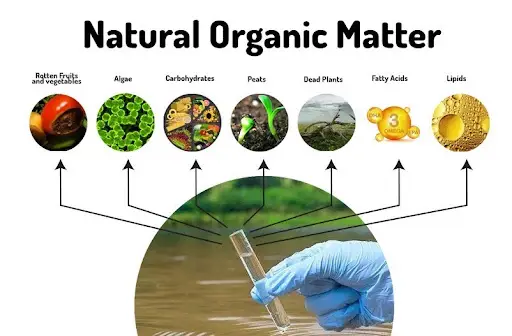
Natural Organic Matter (NOM) is a collective term for naturally occurring organic matter in water sources, especially in surface water in the form of rivers, lakes, and reservoirs. It’s produced largely from plant and animal decomposition, such as leaves, algae, soil or humic substances and microorganisms.
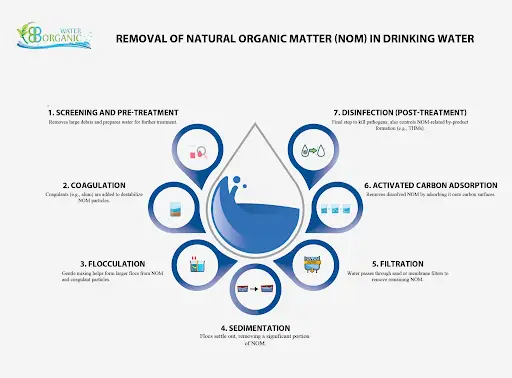
NOM is not a single compound but a whole family of organic molecules including humic acids, fulvic acids (organic compound found in soil), proteins, carbohydrates and many other derivatives of various elements, withvariations depending on the ecosystem and the climate.See the diagram to understand more about “Natural Organic Matter” in drinking water.
What even is Natural Organic Matter in Drinking Water (NOM)?
Decayed leaves, algae, soil, dead microorganisms and other waste products of nature all decomposing into water sources
Not just one, a whole family of organic molecules (humic acids, fulvic acids, proteins, carbs etc.).
Commonly wintering in surface waters such as lakes, reservoirs, rivers
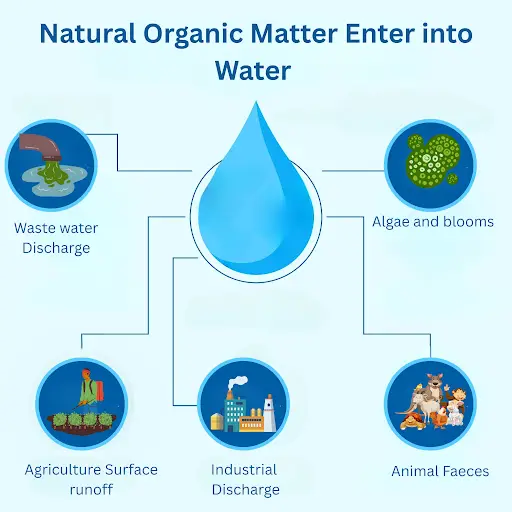
 How does Natural Organic Matter get into the water?
- Rain washing through forests/soil = free NOM delivery
All of this contributes Farm runoff, decaying plants, wastewater discharge.Farm runoff, decaying plants, waste water discharge all contribute.
Water levels fluctuate seasonally and where it comes from (not constant)
Students will learn what scientists are doing when they “read” NOM, or do the detective work.
NEP (Net Ecosynthesisic Production) basic load-check with bio carbon as substitutes for traditional carbon; MORE bio carbon = MORE substitutes for traditional carbon;
MORE = NEP = net ecos-synthesisic production
Color (Color) scattered light in water, which is visible by the human eye, or measured instrument; the higher absorbance = the more organic matter is present in water
Targeted Removal: Size Exclusion Chromatography separates the NOM according to its size (the big chunks from the very tiny particles).
Next generation structural fingerprinting: NMR & Fluorescence Spectroscopy.
What’s in there?
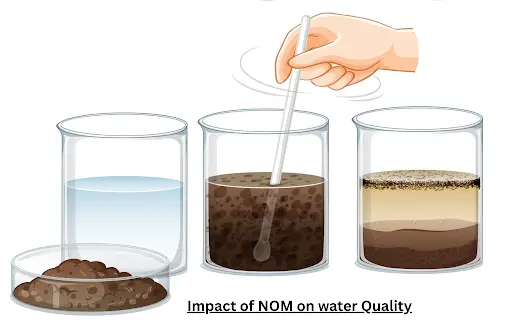
Clogs filter membranes = increased maintenance and additional cost of service.
If left untreated – turns clean water bodies into polluted water body (aqua life also suffers)
🛠️ How treatment plants fight back
Source protection
No deforestation around water, buffer zone etc. less agricultural runoff.
Coagulation & Flocculation — Chemicals cause NOM to “floc” out that can be removed.
In this process, the water is filtered on the one hand using sand filters, on the other hand through the use of activated carbon (GAC) or through so-called bacteria nourished biofiltration.
Advanced Oxidation (AOPs) —UV/H2O2 combination to destroy recalcitrant NOM.
Smarter disinfection – replacing/optimizing chlorine to prevent DBPs forming in the water.
Regular flushing to prevent NOM/DBPs from accumulating in the pipe, after treatment.
🩺 Health & environment tea
Rheumatoid erythematosus and kidney disease are all a result of chronic exposure to DBP.Liver/kidney damage/diseases and cancer risk are all side effects associated with chronic exposure to DBP.
Complete disinfection = lower risk of diarrhea, cholera.
Environmentally: NOM rich run-off water is responsible for algae blooms and oxygen depletion in water bodies.
TL;DR: NOM is not dangerous, just when it reacts with chlorine. Treatment good means that it is captured first (before disinfection).
Characterization of NOM
The Characterization of Natural Organic Matter in Drinking Water is simply, determining or working out and organic compound’s nature or quantifying the amount of NOM that affects its presence in water, characteristics of all substances are not the same, some are large, some are complex and some are small, some are even micro biodegradable. Through Characterization, scientists and water treatment professionals can make a relatively simple decision about how to best reduce NOM and ensure drinking water safety and quality.
A number of methods have been developed to characterize NOM. Firstly it is measured for its Dissolved Organic Carbon (DOC) concentration, then it is analysed for molecular weight and finally it is measured for its UV absorbance. These measurements are used to determine the removability of NOM and have also been used to assess whether NOM might be able to create a disinfecting by-product (DBP) that may be harmful during the disinfection process. For instance, NOM, in particular, is higher, the more DBPs are required since removal is needed and does not raise health risks.
NOM Characterization Techniques
Discussed below is some of the techniques used for the removal of NOM from discus:
Dissolved Organic Carbon
The method is easy to disinfect the effect of NOM. The first is the amount of dissolved organic carbon (DOC) which is a general indicator of water load.
The greater the amount of DOC, the greater will be the potential to destroy the harmful elements in the process of disinfection. Moreover, once carbon is quantitated it gets converted to carbon dioxide.
UV Absorbance
This method is a combination of DOC and UV (Ultra Violet) Light at a wavelength of 254 nm (nanometer). The UV254 light helps to absorb the organic compounds in water; higher light means higher NOM present in water, and chlorine is used to disinfect the organic compound as the higher the weight of the compound, the higher amount of chlorine is used, which gives harmful by-products for public use.
Thus, the advanced oxidation to remove NOM is safe and secure.
A range of Specific UV Absorbance (SUVA) < 2 indicates that low UV doses are used to destroy NOM; greater than SUVA of 4 indicates high doses of UV are used and this is detrimental.
Size Exclusion Chromatography
In this technique, the NOM is fractionated into large, medium and small sizes and water passed through a gel-like filter and using the experience of coagulation large materials are removed. While the small ones are removed by the advanced filtration method.
Nuclear magnetic resonance
Used to study the structure of molecules: Place elements in a magnetic field; release energy and provide a fingerprint of the scientific community that tells about the structure.
Fluorescence spectroscopy
This method employs UV to shine on water samples. In water, light is absorbed by molecules, and a pollutant emits energy known as fluorescence, at another wavelength, which can be used to help eliminate the pollutant from a water sample.
Impacts of NOM on Water Quality
Natural Organic Matter(NOM) affects the quality and safety of drinking water. It can lead to several water quality problems if not properly managed. Below are the main impacts:
5 Removal Approches For NOM
Risk management for Natural Organic Matter (NOM) in drinking water involves a series of practical steps and scientific understanding aimed at reducing its presence and controlling its potential to form harmful disinfection by-products regulated by environmental health standards.
Source Water Protection
Removal of NOM and provision of source water protection is the first and most important step in risk management. This is an important step and includes steps of reducing NOM at the source and also limiting forest litter, algae blooms, agricultural runoff and sewage leaks. The need and importance of this action is not overstated. No deforestation or too close farming to water is recommended.Using vegetative barriers to remove NOM before it reaches the water bodies.
Monitoring and NOM Characterization
Regular tests are taken at water treatment plants:
Total Organic Carbon (TOC)
The quantity of dissolved organic carbon (DOC) in the water can also be measured.
The Absorbance at 254 nm indicates the presence of organic matter containing UV-absorbing aromatics (UV254 Absorbance, a surrogate for aromatic organic matter).
SUVA (Specific UV Absorbance) to evaluate NOM’s reactivity
This step helps in analyzing the concentration of NOM and determining how likely it is to form DBPs during treatment.
Monitoring and NOM Characterization
Water treatment plants routinely monitor:
This step helps in analyzing the concentration of NOM and determining how likely it is to form DBPs during treatment.
Coagulation and Flocculation
It is the first major treatment process to remove NOM:
Filtration
NOM that passes through coagulation for water treatment and it is further removed by:
Advanced Oxidation Processes (AOPs)
If NOM persists, advanced chemical treatment is used when the level of NOM is high and the limits of DBPs are exceeded:
Disinfection Management
Chlorine dose is optimized or replaced with alternative disinfectants:
Distribution System Maintenance
Even after treatment, NOM or DBPs can accumulate:
Effect of Natural Organic Matter in Drinking Water on health
Effect of Natural Organic Matter in Drinking Water on the environment
FAQs
Conclusion
The presence of Natural Organic Matter in Drinking Water (NOM) is a natural phenomenon of surface water that poses an enormous problem in the field of drinking water quality. It is produced when plants and animals decay, but can also contribute to the presence of unwanted taste and color and most importantly undesirable disinfection by-products (DBPs) in water treatment. Knowing the sources, nature and effects of NOM is fundamental to the selection of water treatment technologies. But, there, our duties are not completed. Good risk management practices, protection of source water, monitoring, and applying state-of-the-art and innovative treatment technologies can reduce NOM and provide safe, clean and affordable drinking water to communities.