Drinking Water Treatment
Elements essential to life can be treated to its original creation. This can be done with water due to the simplicity yet diversity of the molecule bonding. Treatment involves several steps for purifying safe consumption for human use, especially for drinking. Since water has deep imprints on life it is difficult for natural sources to remain untouched the impurities, includes microbes, harmful chemicals, and suspended solids.
If consumed, the water borne disease leads to serious health problems. Tap water is not fit for drinking. In household primary water purification can be achieved by boiling to 100C, 212F for 1 minute but this method is not applicable for all micro-organisms. But boiling can eliminate Escherichia coli, Cholera, Typhoid fever; however Clostridium, Botulism, Anthrax etc. survive in high temperatures.
Goal Of Water Treatment
The goal of drinking water treatment is to eliminate dangerous elements, safe drinking water is the right of every citizen, purified water should at least meet public health standards and guidelines recommended by the WHO. Many viruses and bacterias become active in the summer season and can be spread through fluids. Most micro-organisms dies by different treatments.
3 Steps of Water Treatment
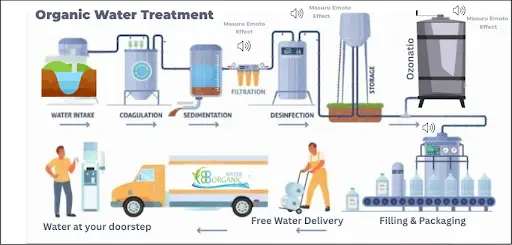
There are three basic steps involved in water treatment and disinfection takes place
What are the results of Drinking Water Treatment?
Drinking water treatment removes contaminations from water obtained from underground sources or from open sources. Rain washes everything leaving clean and pure; but atmospheric pollution has effects even on the rain falling from sky and also when it comes in contact with the earth surface. Rain absorbs air pollutants from burning fossil fuels.
The industries involved have diverse effects not only on the natural phenomena of rain but they have altered weather conditions globally like sulfur dioxide and nitrogen oxide get absorbed falls as acid rain. Which has the worst effect on humans and crops both not only chemical changes, rain also brings down heavy metals like lead, mercury, pesticides, herbicides, polycyclic aromatic hydrocarbons released into air through industrial combustion.
Groundwater depends on the geology of the area. If the area is on hillside or mountainous there are most chances water must be bitter with impurities like salt, magnesium, iron etc.These pollutants can cause serious health risks if consumed, making treatment essential to ensure the water is safe for human use.
List of Pollutants Removed from Water
Pollutants found before water treatment have organic or inorganic effects that water treatment has various methods for purification depending upon the type of pollutants, which is faced by water being the universal solvent.
Organic Matter Removal
Organic materials, both natural and man-made, are often found in untreated water sources. Which take place due to decaying of vegetation, microorganisms, agricultural waste, decomposing plant and animal material, soil erosion, pesticides and industrial discharge.
The untreated water has a bad effect on the taste, odor, and color, which is definitely unsafe for consumption. Organic matter when treated with disinfectants like chlorine harmful by products such as trihalomethanes and haloacetic acids with carcinogenic properties are formed.
The process for removing organic matter is called coagulation and flocculation.
Non-Organic Matter
In organic or non-organic substances do not contain hydrogen carbon bonds; they are caused by mineral sources, industrial processes and human activities found in water that come from non-living sources.
- It’s essential to treat water in organic matter as these contaminants do not break down naturally with time, on the contrary they get accumulated in the body causing long term health damage.
- Some water treatments help in leaving water pure and hygienic, this include Reverse Osmosis process, Ion exchange method.These inorganic contaminants are eliminated by Reverse Osmosis, Ion exchange method, and other techniques, such as sedimentation.
Organic Micro Pollutants
Organic micropollutants are usually at the microgram or nanogram per liter level. They naturally occur in water in very low concentrations, but they are harmful to human.
Heavy Metal Removal
Heavy metal contamination is the worst and highly dangerous form of contamination that include lead, arsenic, mercury, cadmium and chromium the major source of which is industrial waste, pesticides from agricultural waste, corrosion of pipe lines etc. Even the exposure to low concentrations of heavy metals can have a deep effect on kidney, nervous system disorders and cancers.
The Different Treatment Steps For Drinking Water:
Several Steps are involved in the treatment of drinking water that produces quality water, safe for human health. The steps we discuss below:
Aeration
Aeration is the essential part of water treatment since everything on earth, returns to equilibrium and to its most natural form. The same thing is applicable for water also. Water is brought in contact with pure oxygenated air to improve water quality. This allows unwanted dissolved gases like hydrogen sulfide and carbon dioxide to escape from the water through the atmosphere.
Coagulation
Coagulation, a chemical process involving the addition of coagulants (such as alum) to water, the suspended particles present in water making it unclear are destabilized by clumping tiny particles the heavier particles settle at the bottom.
Flocculation
Flocculation is a crucial and controlled physical process which follows coagulation. Destabilizing of particles gentle mixing process that allows destabilized particles to form larger clusters called ‘flocs.’ This process involves a slow and steady mixing of the water, encouraging the particles to come together and form these larger clusters, which makes them easier to settle and later to be removed. For the purpose large tanks or basins that are designed to provide the ideal conditions for floc growth. These tanks have multiple compartments.
They are designed in a way which aids flocs to grow quickly in the first compartment, the particles then collide and stick together. As the water moves through the later compartments, the mixing becomes gentler, allowing the larger and more delicate flocs to strengthen and become denser without breaking apart. This is called hydraulic retention which takes place within 20 minutes and an hour depending on the type of contamination for which water is being treated.
Sedimentation
Sedimentation takes place in large built in tanks called clarifiers or settling tanks. These tanks lower the water velocity without disturbing the water this helps gravity to work on the suspended floc particles and and pull the maximum suspended particles at the bottom of the tank. The water is then made flowy slowly and steadily leaving the suspended particles behind at the bottom of the tanks. This depends mostly on the size and depth of the tanks and the time the large particles need to settle down the smaller suspended particles take much more time to settle.
Filtration
- In filtration removing suspended particles, microorganisms, and certain dissolved substances from water takes place by passing it through a porous material called filter media. After coagulation, flocculation and sedimentation this process removes almost all the microbiological and synthetic chemicals present in water through filter media. This media which acts as a physical straining and adsorption barrier which retains contaminants allowing clean water to pass through.
- For the purpose the ground water is tested where the water received after sedimentation is tested to find out which filter media should be best for removing the contaminations. The ideal filter medium must be porous with good mechanical strength to stand the pressure of filtration and backwashing and chemical stability as well so that no reaction take place between water and media, nothing leaches and effectively clean the media filter most commonly used for water filtration is sand, anthracite coal, gravel, activated carbon, and garnet.
Types of Filter Media
- Sand This is the most used filter medium; the accuracy depends on the size of grains,it helps in removing turbidity, suspended solids, and most microbial contaminants, making it a reliable and cost-effective choice for both large municipal water treatment plants and smaller community water systems. Sand filters need periodic backwashing to remove accumulated solids that enhance filtration capacity.
- Anthracite Coal A carbonaceous form of coal which has larger grain size and lower density it forms a porous filter allowing water to flow rapidly. The larger particles are captured in the anthracite layer near the top of the filter and the finer particles penetrate deeper, captured by the finer layer of sand beneath it. Anthracite is used for high turbidity to handle high turbidity with its resistance to chemical degradation has made it the best choice.
- Gravel is typically used as a support medium rather than a primary filtration medium in water treatment filter systems. It is placed at the bottom of the filter bed, sand or anthracite, it provides structural support stopping finer media from being washed during filtration and back washing. The coarsest gravel is set at the bottom to provide structural support and prevent the finer media from being washed into the underdrain system during filtration and backwashing this make the backwash water evenly across the entire base of the filter so that uniform cleaning and rejuvenating can take place
- Activated Carbon Activated carbon is one of the most versatile and powerful filter media used in advanced water treatment, the remarkable absorption capacity is achieved by treating coal, coconut shells or wood at a very high temperature without oxygen. 1 gram of activated carbon can clean a surface area of up to 1,500 square meters by dissolving organic compounds, eliminating metallic taste and odor causing substances like chlorine, chloramines, pesticides, herbicides, pharmaceutical compounds, and other micropollutants can attach and be removed easily from the water.
In market activated carbon is available as granular activated carbon (GAC) and powdered activated carbon (PAC). Where granular activated carbon GAC is used as a layer in multimedia filter systems, and powdered activated carbon i.e. PAC is added directly to the water as a powder can be later removed through sedimentation or filtration. Activated carbon filtration is highly recommended for micropollutants, a better option than conventional filtration processes.
- Garnet is a dense, hard, and chemically inert mineral that is used as the bottom layer of fine filtration media in multimedia filter systems. Garnet is particularly useful in filters treating water with high concentrations of fine colloidal particles to obtain high water clarity.
- Diatomaceous Earth occurs naturally, soft sedimentary rock composed of the fossilized remains of tiny aquatic organisms called diatoms, it provides highly porous and fine filtration material. They remove minute particles, like Giardia cysts, Cryptosporidium oocysts, algae, and some bacteria, making them particularly valuable for removing high levels of microbiological.
Disinfection
- Disinfection is the process of killing or inactivating harmful microorganisms with the help of chlorine, chloramine, Ozone and ultraviolet light, these damage the DNA of microorganisms
- It is done as the very last protocol. It protects against waterborne diseases.
- This very last process ensures water is safe for drinking.