Water Quality Standard and Guideline
Clean safe water is the fundamental right. It is the loyal commitment of the government to guide suppliers of drinking water to follow the guidelines of the World Health Organization (WHO); they set standards to produce quality water and prevent public health issues, ensuring the safety of the public.
These standards define acceptable limits for various contaminants in drinking water and provide a framework for ensuring water is safe, reliable, and accessible to all.WHO promotes a preventive model emphasizing the identification and mitigation of risks throughout the entire water supply chain, from source protection to distribution. Aligns with the concept of Water Safety Plans (WSPs), a comprehensive risk assessment and risk management approach that focuses on all steps of water supply, from source to consumer, and is now widely adopted by many countries.
Different parameters of water are recommended to obtain clean drinking water, such as Color, Odour, Taste, Turbidity, pH value, and Total Dissolved Solid; further, we discuss in detail the desirable range and permissible range in the article.
WHO Drinking Water Quality Standard & Guideline
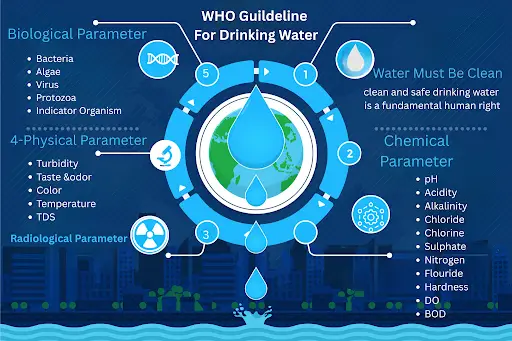
These standards cover a comprehensive range of physical, chemical, biological, and radiological parameters, leaving no aspect of water quality unaddressed. This thoroughness is designed to provide reassurance about the safety and reliability of our drinking water by certification.
Physical Parameters For Water Quality Standard
Physical parameters are measurable characteristics of water that affect its appearance, taste, smell, and general acceptability to users. It’s important to note that these parameters do not directly impact health; providing a comprehensive understanding of water quality related to physical parameters is below:

Physical Properties:
To detect you are being provided with clean water these physical parameters should be kept in front.
Learn more about molecular structure and comprehensive overview of Physical and chemical properties of water in our blog post.
Physical Parameters Depend on Water Source
The type of water source largely influences the quality of physical parameters, and some water sources are defined below:
Surface Water
The exposure to the environment gives water high turbidity, color, and microbial load.
Ground Water
Ground water such as from wells and springs is clearer and calmer with less turbidity and stable temperature, but may have high TDS or minerals due to the enriched deposits.
RainWater
Rainwater harvesting has great results for ground water and water scarcity, its low TDS and turbidity makes it drinkable, but it may absorb atmospheric pollutants.
Desalinated Water
Purified seawater is desalinated water that is very low in TDS and turbidity but requires mineral adjustment for taste and balance.
Chemical Parameters For Water Quality Standard
Chemical parameters depend on the chemical substances and compounds present in water; samples whose quality, safety, taste, and suitability for drinking are compromised have various parameters. These parameters help determine whether the water is safe for human health and promise for water quality standard, which we discuss below:
Element Name | WHO Recommended Range / Guideline Value |
Fluoride | 0.5 – 1.5 mg/L |
Nitrate | 50 mg/L (as nitrate) |
Nitrite | 0.2 mg/L (as nitrite) |
Chloride | 250 mg/L (not health-based, aesthetic guideline) |
Sulfate | 500 mg/L (aesthetic guideline) |
Iron | 0.3 mg/L (aesthetic guideline) |
Manganese | 0.4 mg/L |
Copper | 2.0 mg/L |
Zinc | 3.0 mg/L |
Lead | 0.01 mg/L |
Arsenic | 0.01 mg/L |
Cadmium | More or less 0.003 mg/L |
Mercury | More or less 0.006 mg/L |
Calcium (for hardness) | Not specified; contributes to total hardness |
Magnesium (for hardness) | Not specified; contributes to total hardness |
TDS | 1000 mg/L (aesthetic guideline) |
Residual Chlorine | 0.2 – 0.5 mg/L (at point of delivery) |
pH Value | 6.5 – 8.5 (acceptable range) |
List of Chemical Parameters
Biological Parameters For Water Quality Standard
Biological parameters refer to living organisms like bacteria, protozoa, algae, and others. These parameters are unsafe for human use; we discuss these biological parameters:
Bacteria
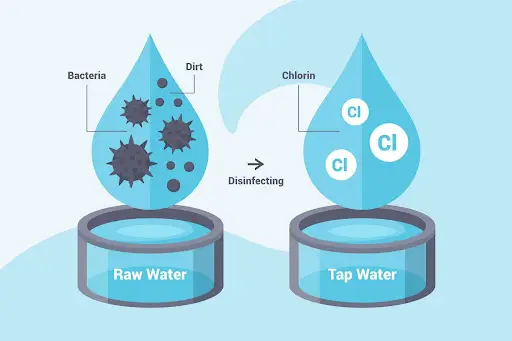
Bacteria are microscopic uni cellular organisms. They reproduce rapidly, bacteria can multiply quickly in warmer temperatures, leading to a higher risk of contamination.
It is present in three different shapes, such as rod, sphere and spiral. Pathogenic bacteria are harmful to human health, which weakens immune systems, and cause typhoid and cholera.
Algae
Algae are naturally present in water bodies; they are plant-like simple structures. Which grows when there is a lack of oxygen in the water algae produce. Stagnant and in the summer season, water gives algae a stable environment to grow undisturbed.
Virus
Viruses are like parasites that cause infections in living things. It cannot live or grow on its own, so it enters the cells of humans, animals, or plants to make more copies of itself. Viruses are responsible for many diseases, including the flu, colds, and hepatitis. They are made up of genetic material (DNA or RNA) and a protective protein shell. Some also have a fatty outer layer. Once inside a host, viruses can quickly multiply and spread.
Protozoa
Protozoa are microscopic unicellular organisms that live in water, soil, and inside other living organisms. They are a type of parasite that can survive in both clean and contaminated environments.
Protozoa typically enter water sources through faecal contamination, especially from humans or animals carrying the parasites.
Indicator Organism
In clean water the indicator organisms do not grow in natural parameters.Human and animal waste – from sewage, open defecation, or livestock runoff Leaking septic systems or damaged sewer lines.
Radiological Parameters of Drinking Water
The radiological parameters maintain the natural parameters of water. It is important to ensure the water is safe from radioactive contamination. This impurity damages human cells and DNA if consumed in high amounts over time.
Range of Radioactive Parameters according to WHO
Radon: ≤100 Bq/L
Gross Alpha Activity: ≤0.5 Bq/L
Gross Beta Activity: ≤1.0 Bq/L
Core Principles of Safe Water
Health Protection
Water Accessibility
Sustainability
Continuous Monitoring and Improvement
Multi-Barrier Approach
WHO Guidelines for Water Quality Standard (Key Points):
Public Health Authorities and Water Quality
Water Resource Management
Water resource management means the management of the Earth’s water resources to meet the needs of people, industries, agriculture, and the environment.
Effective management ensures there is enough clean water available for drinking, sanitation, farming, and industrial use, both now and in the future.
This process involves protecting water sources from pollution and maintain water quality standard. Making sure we use water responsibly means without wastage, so that the level of groundwater will balance, which ensures the health of natural ecosystems.
They are well prepared to deal with climate change, population growth, and droughts, and are responsible for managing public health, economic growth, and environmental stability.
Conclusion
Safe drinking water is the Public Health right for all. The World Health Organization’s water quality standard has formulated a framework for assessing and maintaining water safety across physical, chemical, biological, and radiological parameters. These guidelines serve not only as regulatory tools but also as a foundation for sustainable water management and health protection.
Implementation of this standard by the government, water agencies, and communities must ensure the consistent delivery of clean, safe, and tasty water. The integration of Water Safety Plans maintenance plays a vital role in reducing risks and building public trust in the water supply.