Can Water be Organic?
Since the organic compounds need carbon-hydrogen bonding. This signifies water in nature is an inorganic compound due to the Oxygen Hydrogen bonding.
To know more about this, lets dig into the article Can Water be Organic or Inorganic Compound? Where we explain its classification, physical and chemical characteristics of water, etc., in more detail.
What does Organic mean?
Organic is the term generally used for products that occur naturally in nature without additives and preservatives to increase shelf life or quality enhancement.
How can Food be Organic?
Food comprises the food pyramid: fats, Oil plus sweets sit at the top. After that, you’ve got meat along with fish. Eggs show up next, followed by milk. Then come fruits – right after those are greens and veggies. At the bottom, there are grains and carbs like rice, bread, or pasta.
Here’s the thing – could a meal ever count as synthetic or purely lab-made if it starts with stuff from nature?
So, the question remains: can food be in any way organic or inorganic when it is prepared from natural ingredients?
The Role of Chemicals in Food
The impact of substances helps boost taste, freshness, look, or odor. Chemical impact on food by heating, adding, or dipping. These synthetic chemicals remain unbreakable in our body and are later stored as fat by our liver to avoid the risk of metabolizing.
These chemicals have the worst effect on our health if our system does not excrete them as foreign substances.
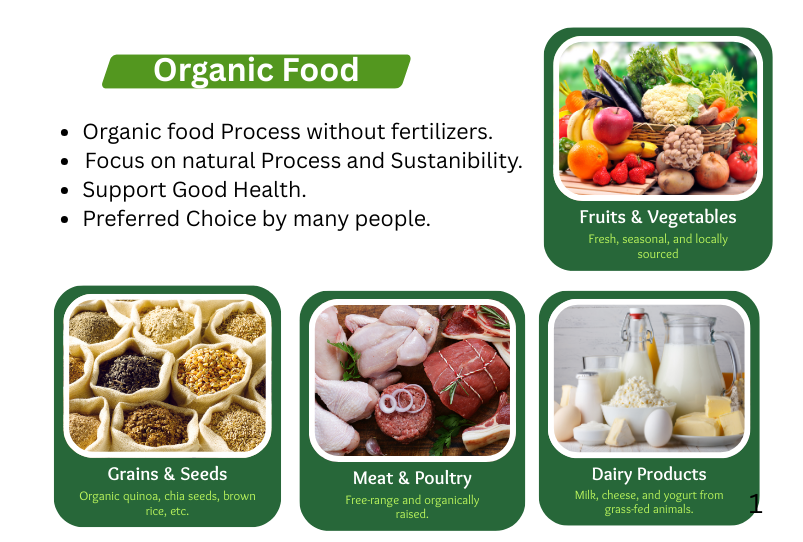
People living away from urban areas are healthier. This has a direct link with the food they consume. The food that they grow in backyards is more organic than the food grown by large industries for general consumption.
To maximize production, land is prepared with chemicals, and fields are showered with dangerous pesticides, which, when applied by the farmers, are applied under high precautionary measures. In order to overcome the fear of food shortage and crop loss, pesticides were designed to save crops from diseases, e.g., fungal and viral diseases, and attacks of insects and animals.
Impact of Pesticides on Food and Environment
Unfortunately, using pesticides over time harms people – especially those applying them out in the fields. Because of that, plants aren’t as varied anymore, while creatures such as bees and birds suffer even if they’re not the target. Over time, pests adapt, leading to tough-to-stop infestations. Instead of relying on chemicals, safer options exist – one example is combining natural controls with smart farming methods. This is how food can be Organic.
But to seek quick results with the usage of pesticides, which have altered the chemistry of soil, crops, and the water stored, many questions need to be answered, like how can these chemicals produce healthy food or provide nourishment to the masses when consumed?
How Fortification Affects Water’s Organic Status
Water’s everywhere on Earth, yet it can still be made stronger somehow. So what does “stronger” mean here? When stuff gets mixed into something to boost how it works, that’s known as boosting it. Still, tossing extra things changes its natural form for sure.So, the question is can water be organic and question arise, What is organic water?
What Is Organic Water?
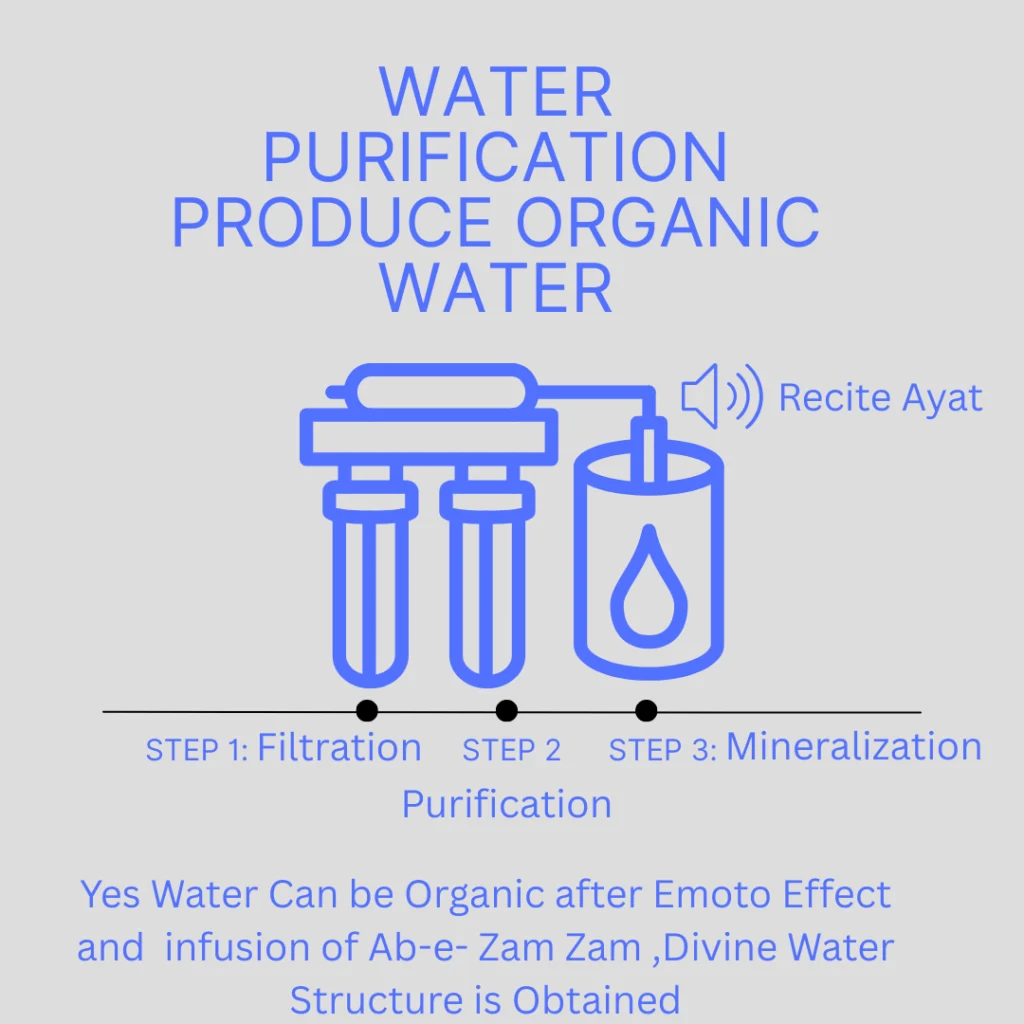
Organic Water: When the water is drawn from the source and is cleaned, the outer shell of the water molecule after osmosis becomes highly unstable. Since we know everything on Earth is in equilibrium, similarly, the water molecules after the Reverse Osmosis process struggle to maintain the natural equilibrium levels at that critical time.
The addition of bioavailable minerals will make sure the water molecules stabilize towards the state of equilibrium with the addition of minerals that are already known and essential for our body, since the water molecules are highly reactive, they incorporate with atmospheric carbon dioxide, making the water acidic.You can study our article to gain information about Physical and chemical properties of water.
At this time addition of O3 gas produces three oxygen bonds in the air. Although the three molecules of oxygen are partially the way of attaining equilibrium themselves, on the other hand, Reverse Osmosis water collected in tanks reacts with both provided compounds. One bioavailable mineral. Secondly, the presence of oxygen molecules O3, helps water molecules to reach equilibrium in the presence of essential minerals, which give water a pH of 7.
Organic Water Available in the Market
In the market, there are types of Organic Water that are collected directly from glaciers, freshwater springs, and lakes. The water collected at the natural resources, no doubt, is fresh, but is it fit for cattle, freshwater plants, and fish, or human consumption? Water from such sources contains contamination of Ammonia, Hydrogen Sulfide H2S, Methane CH4, Organic acids, and Nitrogen, depending on the rotten plants, weeds, and fish. One more thing that we can never forget is human contamination.
From these natural spots where water comes from, one thing pops up – just how safe is it to drink?
Waterfalls tend to move harmful stuff from higher spots – like germs, tiny worms, one-celled creatures, along with various dirty substances. Though they look clean, these drops can bring risky elements downstream because rain pushes debris down slopes. No issue, you can consume this water, but after filtration or boiling, the marketing strategy of collecting drinking water at the very foot of a waterfall or spring is wrong.
Water is life for everyone; this includes bacteria and fungi also.
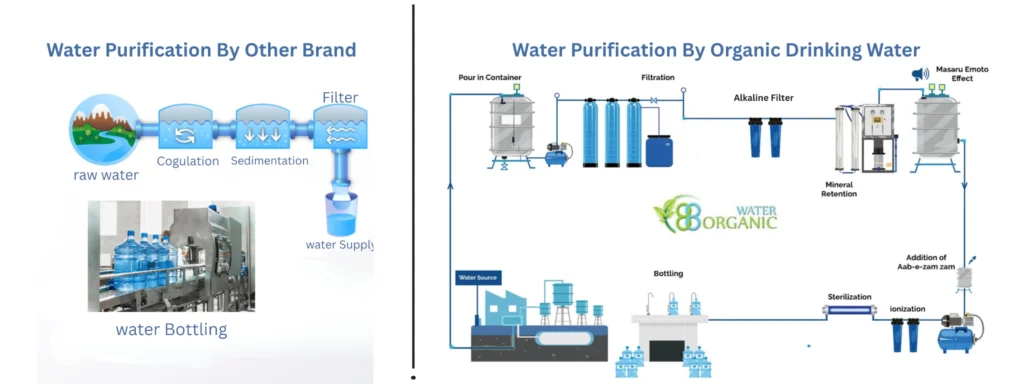
So, how is the water Organic? There are varieties of drinking water: distilled water, Reverse Osmosis Water, Well Water, Streams, and Lake water.
Is distilled Water Organic?
Until now, we discussed the water coming from streams, lakes, and waterfalls. Now we look into distilled water; this is the most aggressive form of water, as the water is collected after condensation and is deprived of mineral addition. Distilled form of water is highly reactive which absorbs nano plastic or anything it comes in contact with. The best form of distilled water is rainwater; you can collect it, store it, and consume it.
Conclusion about Can Water be Organic and fit for consumption
On the other hand, water obtained by reverse osmosis loses bacteria or other viruses during the process, and the term “Organic ” usually reserved for living organism and carbon based compounds.Many people wonder: can water be organic in the context of health & purity.In nature water is in equilibrium and advanced purification allow precise minerals balance that helps the water to approach its equilibrium state quickly. Reverse osmosis is very important since we know everything in nature maintains a certain equilibrium level and helps the elements reinforce their natural form, making them Organic. This water is the ultimate Thirst-Quencher, which not only hydrates us but also rejuvenates our cells.